Airbrush Nozzle Sizes Explained
The number on the box is a trade-off between the finest line you can spray and the thickest paint you can push.
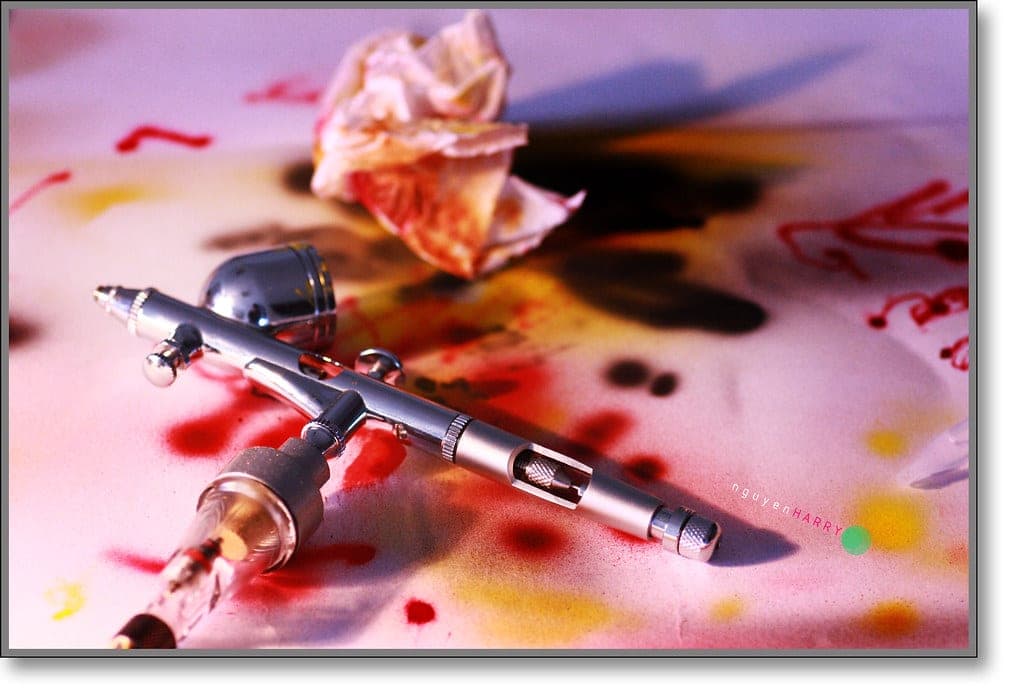
The short answer
Nozzle diameter sets how fine a line you can spray and how thick a paint will pass through. For 32 mm miniatures, 0.3 to 0.35 mm is the right choice: fine enough to basecoat infantry, coarse enough to spray acrylic primer without constant clogging.
The quick version
| # | Product | Best for | Score | Price |
|---|---|---|---|---|
| 1 | Iwata Eclipse HP-CSA 0.35 mm gravity-feed dual-action brush that sprays primer and fine highlights without a nozzle change. The default recommendation for a decade, deservedly. | The 0.35 mm all-rounder | 9.4 | Check price on Amazon |
| 2 | Badger Patriot 105A US-made 0.5 mm workhorse at roughly half the Iwata's price. It will prime and basecoat all day and is forgiving about paint consistency. | Pushing thicker material | 8.5 | Check price on Amazon |
Scores are our own editorial read against the criteria stated below — not a lab measurement and not a user rating. Tap a row for the full write-up.
What the number controls
The nozzle is the aperture the paint is atomized through, and the needle is the taper that opens and closes it. Diameter decides two things at once, in opposite directions:
- Minimum line width. A smaller nozzle can lay a finer line at a given pressure, because less paint leaves per unit of time.
- Maximum paint thickness. A smaller nozzle clogs on material a larger one passes easily. Pigment particles and binder have to physically fit through.
Everything else — pressure, thinning, distance — interacts with those two facts. Which is why “what pressure should I use?” cannot be answered without knowing your nozzle.
The sizes, and who they are for
0.15–0.2 mm. Freehand, camouflage edges, tiny detail. Demands well-thinned paint and low pressure, and clogs quickly on hobby acrylics. A specialist second brush, not a first one.
0.3 mm. Fine-leaning general purpose. Basecoats infantry comfortably, handles most thinned acrylics, needs a little care with primer.
0.35 mm. The pragmatic default for miniatures and the size on the most commonly recommended brushes. Sprays acrylic primer, washes and basecoats with minimal drama, still fine enough for gradients on a 32 mm model.
0.5 mm and up. Primer, terrain, vehicles, varnish. Fast coverage, too coarse for infantry detail.
If you are buying one airbrush for miniatures, you want the 0.3–0.35 mm band, which is the reasoning behind our picks.
Finer is not better
The instinct that a smaller nozzle is a more capable one is the single most expensive misunderstanding in this topic. A 0.2 mm nozzle does not make you a better painter; it makes every mistake in your thinning and your pressure show up as a clog.
There is also a hard ceiling on what nozzle size buys you on a tabletop model. The finest line any airbrush lays down is still wider than the edge highlight on a sword, which is why that highlight is painted with a detail brush on every model you have ever admired.
Needle and nozzle are a matched pair
The needle’s taper is ground to seat in its specific nozzle. Mixing a needle from one size or brand into another nozzle gives you a brush that will not shut off cleanly, drips, or sprays off-axis — and it is a surprisingly common cause of “my airbrush suddenly stopped working” after a parts order.
Three practical rules. Buy needle and nozzle as a set when you change size. Never force a needle into a nozzle to seat it — that is how you flare the nozzle and end its life. And when you reassemble after cleaning, insert the needle from the back slowly until it stops; pushing it home hard is the usual way a tip gets bent.
Reading problems back to nozzle size
- Constant clogging with primer: nozzle too small for the material. Thinning primer is not the fix — see why.
- Spidering and splatter: usually too much pressure or paint too thin for the aperture, not the nozzle itself.
- Cannot get a thin enough line: drop pressure and move closer before you consider buying a finer nozzle.
- Will not shut off / drips: mismatched or damaged needle and nozzle, or dried paint in the seat. See cleaning.
The picks in full
Iwata Eclipse HP-CS
A 0.35 mm gravity-feed dual-action brush that sprays primer and fine highlights without a nozzle change. The default recommendation for a decade, deservedly.
What it gets right
- 0.35 mm is the genuine do-everything size: unthinned-ish primer at one end, zenithal highlights at the other
- PTFE seals tolerate lacquer and alcohol-based paints that eat rubber seals
- Parts are available everywhere, so a bent needle is a cheap fix rather than a new airbrush
Who it is wrong for
- Not the finest line available — a 0.2 mm brush beats it for freehand camouflage
- Open gravity cup is easy to knock over and awkward to decant large volumes into
- Costs two to three times a budget brush, which is hard to justify before you know you will stick with it
Scored against this page’s criteria
Specs from the manufacturer: Iwata-Medea product page
We do not publish prices. Amazon shows the current one, which is the only one that is ever right. #ad · how this is funded
Badger Patriot 105
A US-made 0.5 mm workhorse at roughly half the Iwata's price. It will prime and basecoat all day and is forgiving about paint consistency.
What it gets right
- The 0.5 mm nozzle shrugs off thick primer that chokes finer brushes
- Forgiving spray pattern — it tolerates paint you thinned by eye
- Half the price of the usual recommendation, with parts easily available
Who it is wrong for
- Will not do fine detail; 0.5 mm is a basecoat tool
- Build finish is plainer than the European brushes at the same price
- If you only buy one airbrush, this is the wrong only airbrush
Scored against this page’s criteria
Specs from the manufacturer: Badger Air-Brush Co. product page
We do not publish prices. Amazon shows the current one, which is the only one that is ever right. #ad · how this is funded
FAQ
Questions people actually ask
What airbrush nozzle size should I buy for miniatures?
Is a 0.2 mm nozzle better for detail?
Can I use a needle from a different nozzle size?
Why does my airbrush clog with primer?
More in Airbrushing Miniatures and Models, or start from the beginning with what to buy first.
Sources
- Anest Iwata-Medea — airbrush maintenance and specificationschecked October 2026
- Acrylicos Vallejo — airbrush thinner and Surface Primerchecked October 2026