The Best Airbrush for Miniatures
One tool, three price tiers, and a nozzle size that matters more than the badge on the handle.
The short answer
The Iwata Eclipse HP-CS is the best airbrush for miniature painters: a 0.35 mm gravity-feed dual-action brush that sprays thinned acrylics and primers without clogging, and whose parts are available everywhere. The Harder & Steenbeck Ultra is the better first airbrush if you want to spend less while still buying something serviceable.
The quick version
| # | Product | Best for | Score | Price |
|---|---|---|---|---|
| 1 | 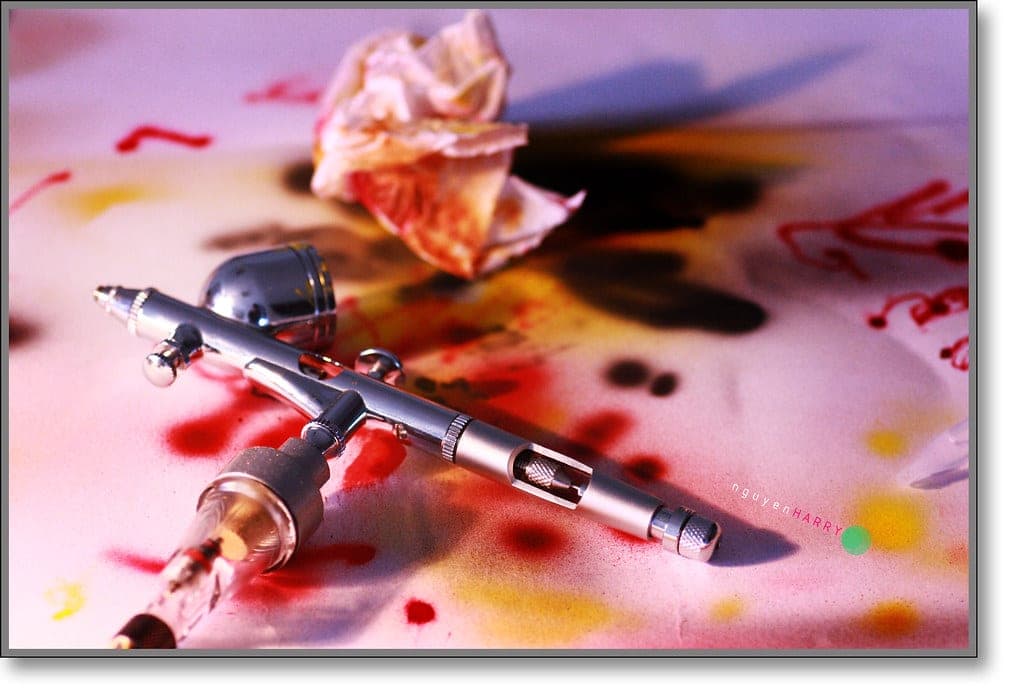 Iwata Eclipse HP-CSA 0.35 mm gravity-feed dual-action brush that sprays primer and fine highlights without a nozzle change. The default recommendation for a decade, deservedly. | The one airbrush to buy | 9.4 | Check price on Amazon |
| 2 | Harder & Steenbeck UltraGerman build at an entry price, with a self-centering nozzle and a trigger limiter that lets you learn control instead of guessing at it. | A first airbrush | 9.1 | Check price on Amazon |
| 3 | Badger Patriot 105A US-made 0.5 mm workhorse at roughly half the Iwata's price. It will prime and basecoat all day and is forgiving about paint consistency. | Priming and basecoating | 8.5 | Check price on Amazon |
Scores are our own editorial read against the criteria stated below — not a lab measurement and not a user rating. Tap a row for the full write-up.
How we picked
- Nozzle size suited to 32 mm models. Around 0.3–0.35 mm is the sweet spot: fine enough for a basecoat on infantry, large enough that acrylic primer passes through without a fight.
- Clog resistance with hobby acrylics. Miniature paints carry more pigment and more binder than illustration inks. An airbrush that only behaves with thin commercial inks is the wrong tool here.
- Cleaning access. You will strip this thing hundreds of times. A needle that comes out without tools and a nozzle you can reach decide whether you keep using it.
- Parts availability. Needles bend and nozzles get damaged. A brush whose spares you cannot buy is disposable, whatever it cost.
- Dual action. Air on the press, paint on the pull. Single-action brushes are cheaper and will frustrate you within a week.
These are editorial picks from published manufacturer specifications and the reasoning here, not a controlled spray test of every airbrush on the market. Our review policy states that plainly.
What an airbrush is genuinely good at
It is not a shortcut to a painted army, and this is where most disappointment comes from. An airbrush is extraordinary at four jobs: priming, basecoating, smooth gradients (zenithal and blends), and vehicles or large models where brush marks would be obvious.
It is bad at everything a tabletop model actually gets judged on up close — edge highlights, eyes, metallics on small trim, freehand. Those remain brush work. Buy an airbrush to make the boring 60% of a model fast and smooth, not to replace your brushes. The honest version of this argument is in do you need an airbrush.
Nozzle size, in plain terms
The nozzle diameter sets the trade-off between how fine a line you can spray and how thick a paint you can push through. For miniatures:
- 0.2 mm and below: fine detail and freehand. Clogs readily with hobby acrylics and is a poor choice for a first and only airbrush.
- 0.3–0.35 mm: the right answer for almost everyone. Handles thinned acrylics, washes and acrylic primer, still fine enough for basecoating a 32 mm model.
- 0.5 mm and above: primer and large surfaces fast. Too coarse for infantry basecoats.
The full explanation, including why a needle and nozzle are a matched pair you should not mix between brands, is in nozzle sizes explained.
Gravity feed versus siphon feed
Gravity feed has a cup on top; paint falls into the brush. It needs less air pressure, wastes almost no paint, and cleans in a few seconds because the cup is part of the body. For miniatures, where you might use 1 ml of paint, this is what you want.
Siphon feed pulls paint up from a jar below. It holds much more paint, which matters if you are spraying a terrain board or a vehicle fleet, and bottles swap without cleaning the cup. For 32 mm models it is the wrong trade.
The cheap airbrush question
Unbranded kits exist at a fraction of these prices, usually bundled with a compressor. They do spray paint. Three things to know before you buy one.
First, nozzle and needle tolerances are inconsistent, and an airbrush is a precision part — a slightly off nozzle sprays unevenly in a way no technique fixes. Second, spares are generally unavailable, so a bent needle ends the tool. Third, and most important for a beginner: when something goes wrong you will not know whether it is you, your paint thinning, or the hardware. Learning on known-good equipment removes an entire category of doubt.
If budget is the constraint, buy the cheapest airbrush on this page with a real spares chain rather than the cheapest airbrush that exists.
What you actually need to spend
The airbrush is between a third and a half of the real cost. Budget for all of it:
- A compressor with a moisture trap and regulator — see the compressor picks. Non-negotiable; water in the line ruins a coat.
- Thinner and flow improver — the additives guide.
- Cleaning kit — brushes, reamers, a wash bottle, and ideally a cleaning pot.
- Somewhere to spray — a window, or a booth.
The picks in full
Iwata Eclipse HP-CS
A 0.35 mm gravity-feed dual-action brush that sprays primer and fine highlights without a nozzle change. The default recommendation for a decade, deservedly.
What it gets right
- 0.35 mm is the genuine do-everything size: unthinned-ish primer at one end, zenithal highlights at the other
- PTFE seals tolerate lacquer and alcohol-based paints that eat rubber seals
- Parts are available everywhere, so a bent needle is a cheap fix rather than a new airbrush
Who it is wrong for
- Not the finest line available — a 0.2 mm brush beats it for freehand camouflage
- Open gravity cup is easy to knock over and awkward to decant large volumes into
- Costs two to three times a budget brush, which is hard to justify before you know you will stick with it
Scored against this page’s criteria
Specs from the manufacturer: Iwata-Medea product page
We do not publish prices. Amazon shows the current one, which is the only one that is ever right. #ad · how this is funded
Harder & Steenbeck Ultra
German build at an entry price, with a self-centering nozzle and a trigger limiter that lets you learn control instead of guessing at it.
What it gets right
- The self-centering nozzle removes the single most common way a beginner wrecks an airbrush
- Trigger limiter lets you cap the paint flow while you build muscle memory
- Shares parts and design language with the pricier Evolution, so it is a real tool not a toy
Who it is wrong for
- Fewer bells than the Evolution — no quick-fix nozzle, simpler cup options
- 0.2 mm version clogs on primer; pick the 0.4 if priming is your main use
- Still needs a compressor, so the true cost of entry is higher than the brush alone
Scored against this page’s criteria
We do not publish prices. Amazon shows the current one, which is the only one that is ever right. #ad · how this is funded
Badger Patriot 105
A US-made 0.5 mm workhorse at roughly half the Iwata's price. It will prime and basecoat all day and is forgiving about paint consistency.
What it gets right
- The 0.5 mm nozzle shrugs off thick primer that chokes finer brushes
- Forgiving spray pattern — it tolerates paint you thinned by eye
- Half the price of the usual recommendation, with parts easily available
Who it is wrong for
- Will not do fine detail; 0.5 mm is a basecoat tool
- Build finish is plainer than the European brushes at the same price
- If you only buy one airbrush, this is the wrong only airbrush
Scored against this page’s criteria
Specs from the manufacturer: Badger Air-Brush Co. product page
We do not publish prices. Amazon shows the current one, which is the only one that is ever right. #ad · how this is funded
FAQ
Questions people actually ask
What nozzle size is best for miniatures?
Do I need a dual-action airbrush?
Is a cheap unbranded airbrush worth it?
Gravity feed or siphon feed for miniatures?
Can an airbrush replace brushes?
More in Airbrushing Miniatures and Models, or start from the beginning with what to buy first.
Sources
- Anest Iwata-Medea — Eclipse and compressor specificationschecked October 2026
- Harder & Steenbeck — Ultra and Evolution rangechecked October 2026
- Badger Air-Brush Co. — Patriot 105 specificationschecked October 2026