An airbrush is the biggest capability jump available in this hobby and the easiest purchase to make too early. It does three things nothing else does well: it primes better than any rattle can, it basecoats a whole army in an evening, and it produces smooth tonal gradients that are extremely hard to achieve with a brush. It also brings a compressor, a cleaning routine, a thinning problem and a ventilation requirement with it.
Whether you need one yet
Probably not for your first army, and the honest reasoning is in do you need an airbrush. The short version: an airbrush saves time on repetitive work. If you have painted ten models, you do not yet have enough repetitive work for it to pay back, and the learning curve will eat the time it saves. If you are priming and basecoating fifty models, it pays back almost immediately.
The one case for buying early is priming. If you cannot spray outdoors — a flat with no balcony, a long wet winter — then an airbrush with water-based primer solves a problem you otherwise cannot solve at all, and that is a legitimate reason.
How the category divides
You are buying three things, and the airbrush is the least important of them.
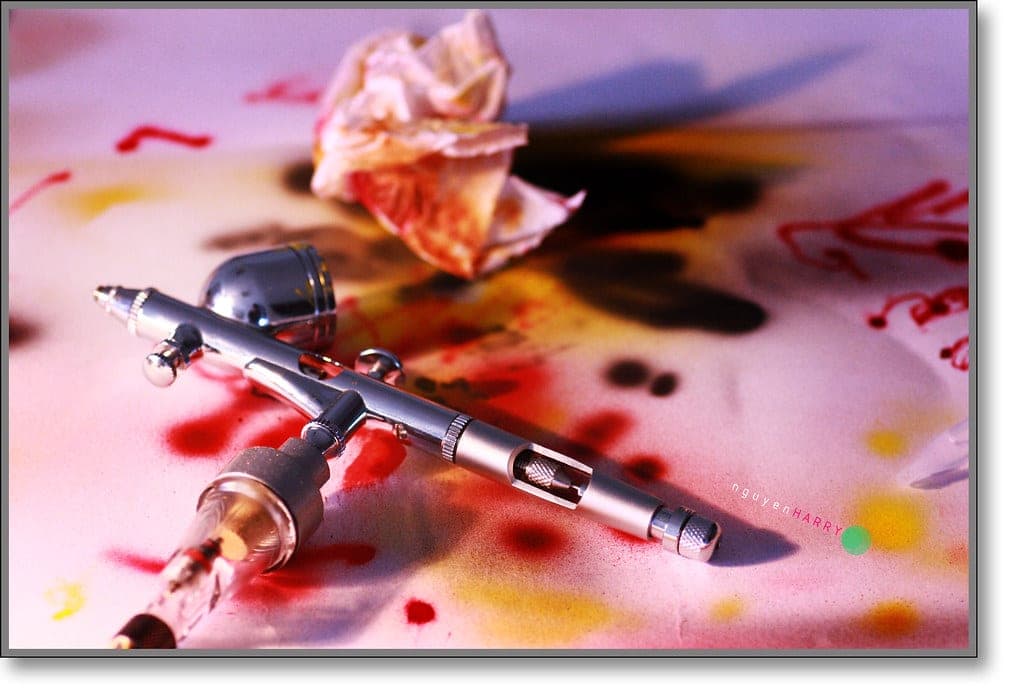
The airbrush is defined by its needle diameter and its feed. Needle size sets what it can do: 0.2 mm for fine freehand work and nothing thicker than well-thinned paint; 0.35 mm as the genuine do-everything size; 0.5 mm for primer and basecoats and not much else. If you buy one airbrush, buy 0.3 or 0.35 mm. Gravity feed (cup on top) wastes less paint and suits small volumes; siphon feed (bottle underneath) holds more and suits priming an army. See gravity vs siphon and single vs dual action — the short answer on the second is that dual action is what you want, and it is not harder to learn.
The compressor is where reliability lives. A tank is the upgrade that matters: stored air gives constant pressure and the motor only runs to refill, so it is quieter and lasts longer. Tank or no tank covers the trade-off, and the compressor picks are here.
The consumables — thinner, cleaner, a cleaning kit — are where new airbrushers under-budget and where almost all the frustration originates.
What decides price
On the airbrush: machining tolerance and seal material. A well-machined nozzle and needle seat is what separates a brush that sprays consistently from one that spits, and PTFE seals tolerate the lacquer and alcohol-based paints that destroy rubber ones. That is a genuine, mechanical difference you can feel from the first pass.
On the compressor: the tank, the regulator and the moisture trap. A cheap unit with a vague regulator and no trap will spit water into your paint on a humid day and you will blame the airbrush.
What does not justify a price difference is the number of nozzle sets in the box. One correctly sized nozzle you use is worth more than three you swap between and wear out.
The mistake buyers make
Paint consistency, every time. Almost every “my airbrush is broken” problem is paint that is too thick, thinned with plain water, or both. Airbrush paint should be about the consistency of milk, thinned with a proper airbrush thinner rather than water, because water dilutes the binder and the paint then will not stick. Thinning paint for an airbrush is the page to read before you blame the hardware, and the thinner picks matter more than most people expect.
The second mistake is pressure. Miniature work lives at roughly 15–25 PSI, not the 40 a general-purpose compressor defaults to; see PSI settings.
The third is cleaning, or rather not cleaning. An airbrush that is flushed between colors and stripped occasionally lasts years. One that is not seizes up and gets replaced. The cleaning routine takes five minutes, and the kit for it costs very little against the airbrush it saves. Ventilation is not optional either — a spray booth handles overspray, though it does not replace a respirator for lacquers.