Single vs Dual Action Airbrush
One trigger controls air. The other controls air and paint. That single difference decides what you can and cannot paint.
The short answer
Buy dual action for miniatures. A single-action trigger only controls air, so paint flow is fixed for the whole pass and you cannot feather an edge or taper a line. Single action is simpler, cheaper and easier to clean, which makes it a good dedicated primer and varnish sprayer, not a good first miniature airbrush.
The quick version
| # | Product | Best for | Score | Price |
|---|---|---|---|---|
| 1 | 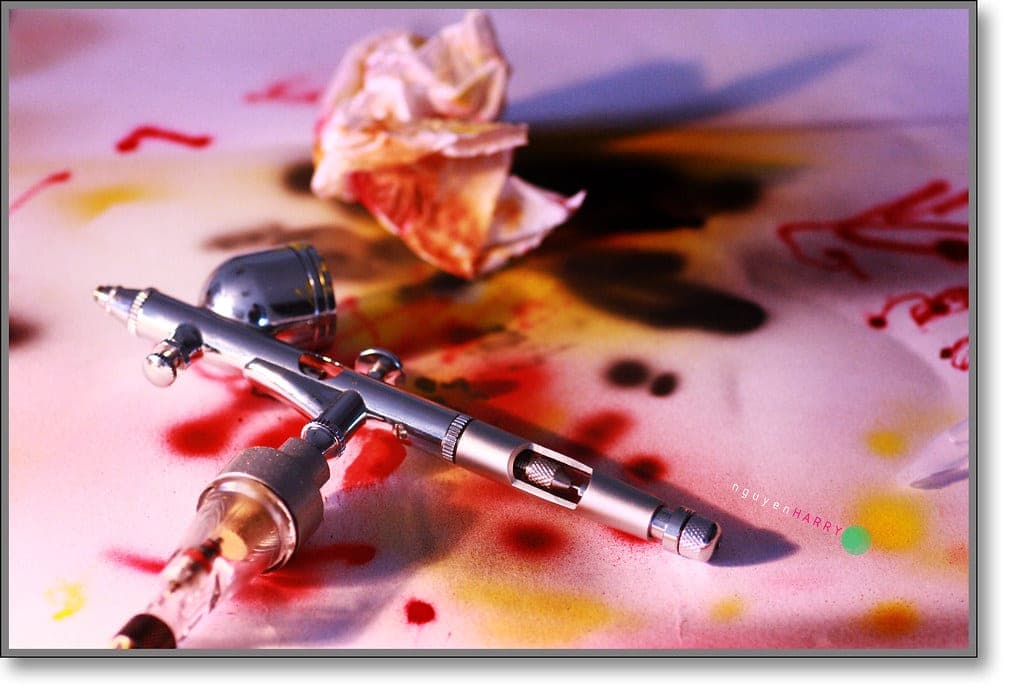 Iwata Eclipse HP-CSA 0.35 mm gravity-feed dual-action brush that sprays primer and fine highlights without a nozzle change. The default recommendation for a decade, deservedly. | Best dual action | 9.4 | Check price on Amazon |
| 2 | Badger Patriot 105A US-made 0.5 mm workhorse at roughly half the Iwata's price. It will prime and basecoat all day and is forgiving about paint consistency. | Best value dual action | 8.5 | Check price on Amazon |
| 3 | Paasche Model H single-action airbrushExternal mix, siphon feed, one trigger that only controls air. You set paint flow with a knob and forget it, which is exactly right for priming and base coats. | Best single action | 7.8 | Check price on Amazon |
| 4 | Master Airbrush Cool Runner II kit with G233 Pro SetCompressor, hose, holder and a dual-action gravity-feed airbrush with three nozzle sets in one box. Nothing here is best in class; everything here works on day one. | Dual action on a budget | 8.5 | Check price on Amazon |
Scores are our own editorial read against the criteria stated below — not a lab measurement and not a user rating. Tap a row for the full write-up.
What each trigger actually does
This is a mechanical difference, not a quality tier. Both types come cheap and expensive.
Single action. Press the trigger and air flows. Paint flow is set separately, by a knob or by how far the needle is screwed back, and it does not change while you spray. One variable, set before the pass.
Dual action. Press down for air, then pull back for paint, and the further back you pull the more paint flows. Two variables, both under your finger, both changing continuously through the pass.
Everything else — detail capability, learning curve, cleaning, price — follows from that one difference.
Why dual action wins on a 32 mm model
A miniature is small, curved and crowded. The useful airbrush techniques on one are zenithal priming, where you fade a light from above into shadow, and soft shading, where a color fades into another across a few millimeters. Both require the paint flow to change during the stroke.
With a single action you cannot do that. You can only spray the same amount of paint everywhere the brush points, which gives you flat coverage — fine for a base coat, useless for a gradient. You also cannot start a stroke with air only, which is how you avoid the blob at the beginning of a pass.
There is a second, quieter reason: internal mix. Most dual-action brushes mix paint and air inside the body, which atomizes finer. Most single-action hobby brushes, including the Paasche H, are external mix, which is coarser by design. The finest line a Model H will draw is roughly 1/16 inch; an Eclipse HP-CS will do a fraction of that.
Where single action is genuinely better
Three real cases, and they are not consolation prizes.
Priming a batch. Set the flow, fill a 2 oz siphon bottle, prime thirty models without refilling a 1/3 oz gravity cup eight times. A single action is a better primer sprayer than a dual action, and it costs a third as much.
Varnishing. Same argument. Flat, even coverage of a thin clear coat with nothing to modulate.
Cleaning. An external-mix single action cleans by wiping the tip. No needle to pull, no nozzle to split, no chance of ruining a $25 part with a reamer. If cleaning anxiety is what is stopping you, this matters.
Is dual action harder to learn?
Slightly, for about an hour. The coordination — down for air, back for paint, forward before you release — is genuinely awkward at first and then it is not. Practice on paper, not on a model: draw lines, dots and fades until the trigger stops being something you think about.
What is actually hard about airbrushing is paint consistency and pressure, and those are identical on both types. Nobody fails at airbrushing because of the trigger; they fail because the paint was too thick. See how to thin paint for an airbrush and PSI settings for miniatures.
The verdict
One airbrush, miniatures: dual action, gravity feed, 0.3 mm. That is the Eclipse HP-CS or the Patriot 105, or a budget G233 if the money is not there yet.
Two airbrushes, eventually: a dual action for everything on the model, and a cheap single action kept permanently loaded with primer or varnish so you never clean one to switch tasks. That second brush is a convenience purchase, and it is the one experienced painters quietly recommend. The full ranked picks are in the best airbrush roundup, and the gravity-versus-siphon half of this decision is bound up with nozzle size and set out in full in gravity feed vs siphon feed.
The picks in full
Iwata Eclipse HP-CS
A 0.35 mm gravity-feed dual-action brush that sprays primer and fine highlights without a nozzle change. The default recommendation for a decade, deservedly.
What it gets right
- 0.35 mm is the genuine do-everything size: unthinned-ish primer at one end, zenithal highlights at the other
- PTFE seals tolerate lacquer and alcohol-based paints that eat rubber seals
- Parts are available everywhere, so a bent needle is a cheap fix rather than a new airbrush
Who it is wrong for
- Not the finest line available — a 0.2 mm brush beats it for freehand camouflage
- Open gravity cup is easy to knock over and awkward to decant large volumes into
- Costs two to three times a budget brush, which is hard to justify before you know you will stick with it
Scored against this page’s criteria
Specs from the manufacturer: Iwata-Medea product page
We do not publish prices. Amazon shows the current one, which is the only one that is ever right. #ad · how this is funded
Badger Patriot 105
A US-made 0.5 mm workhorse at roughly half the Iwata's price. It will prime and basecoat all day and is forgiving about paint consistency.
What it gets right
- The 0.5 mm nozzle shrugs off thick primer that chokes finer brushes
- Forgiving spray pattern — it tolerates paint you thinned by eye
- Half the price of the usual recommendation, with parts easily available
Who it is wrong for
- Will not do fine detail; 0.5 mm is a basecoat tool
- Build finish is plainer than the European brushes at the same price
- If you only buy one airbrush, this is the wrong only airbrush
Scored against this page’s criteria
Specs from the manufacturer: Badger Air-Brush Co. product page
We do not publish prices. Amazon shows the current one, which is the only one that is ever right. #ad · how this is funded
Paasche Model H single-action airbrush
External mix, siphon feed, one trigger that only controls air. You set paint flow with a knob and forget it, which is exactly right for priming and base coats.
What it gets right
- Almost nothing to learn — press for air, and paint comes out at the rate you dialed in
- External mix means cleaning is wiping a tip, not stripping a needle from a body
- Siphon bottles hold far more paint than a gravity cup, so a whole batch of primer runs unattended
Who it is wrong for
- The spray pattern is coarser than any internal-mix brush; it will not do a 1 mm line
- No paint control from the trigger, so you cannot feather an edge mid-stroke
- Siphon feed needs more pressure to lift paint, which means more overspray on a 32 mm model
Scored against this page’s criteria
Specs from the manufacturer: Paasche product page
We do not publish prices. Amazon shows the current one, which is the only one that is ever right. #ad · how this is funded
Master Airbrush Cool Runner II kit with G233 Pro Set
Compressor, hose, holder and a dual-action gravity-feed airbrush with three nozzle sets in one box. Nothing here is best in class; everything here works on day one.
What it gets right
- One purchase, one afternoon — no working out which hose fitting matches which compressor
- Three nozzle sets let you find where 0.3 mm stops being enough without buying another airbrush
- Parts are cheap and everywhere, which matters on the airbrush you learn to strip
Who it is wrong for
- Machining tolerances are visibly behind an Iwata or a Harder & Steenbeck; the needle seats less consistently
- No air tank, so you get pulse at low pressure unless the kit includes a moisture trap and regulator
- The bundled paints in some versions are filler, not hobby-grade miniature paint
Scored against this page’s criteria
Specs from the manufacturer: Master Airbrush product page
We do not publish prices. Amazon shows the current one, which is the only one that is ever right. #ad · how this is funded
FAQ
Questions people actually ask
Should a beginner buy a single or dual action airbrush?
What is the difference between single and dual action?
Is a single action airbrush good for priming?
Can you do fine detail with a single action airbrush?
More in Airbrushing Miniatures and Models, or start from the beginning with what to buy first.
Sources
- Paasche Airbrush — Model H specificationschecked October 2026
- Iwata-Medea — airbrush and compressor specificationschecked October 2026