The Best Spray Booth for Airbrushing
A booth is a fan, a filter and a hose in a box. The one that matters is the fan, and the specification nobody prints is how far it has to push the air.
The short answer
For most hobby desks a large folding booth with a 25 W extractor, LED lighting and a turntable is the right buy: it takes a Gunpla kit, vents out of a window and folds flat afterwards. If the booth can live on a dedicated bench permanently, a steel booth with a 6-inch 235 CFM fan extracts far more air and does it more quietly.
The quick version
| # | Product | Best for | Score | Price |
|---|---|---|---|---|
| 1 |  Master Airbrush Large Portable Spray Booth (MAS B550LK)A 22-inch folding booth with a 25 W extractor, LED lighting and a turntable. Big enough that a Gunpla kit on the turntable is not touching the walls, and it still folds flat when the table has to become a table again. | Best spray booth overall | 8.7 | Check price on Amazon |
| 2 | Portable hobby spray booth with extractorA collapsible box with a fan, a filter and a duct hose. Not a substitute for a respirator, but the difference between overspray on the wall and overspray out of the window. | Best budget booth | 8.4 | Check price on Amazon |
| 3 | Master Airbrush Dual-Fan Spray Booth Kit (MAS B3000)Two fans instead of one, four LEDs, a turntable and a six-foot hose. The pick if your window is across the room, because a long duct run is exactly what kills a single-fan booth. | Best airflow in a folding booth | 8.4 | Check price on Amazon |
| 4 | Paasche HSSB-22-16 Hobby Shop Spray BoothA steel bench booth with a single 6-inch fan rated at 235 CFM and 47 dB, ducted to a 4-inch dryer hose. It does not fold, it is not light, and it extracts more air more quietly than any folding box. | Best permanent bench booth | 8.9 | Check price on Amazon |
| 5 | 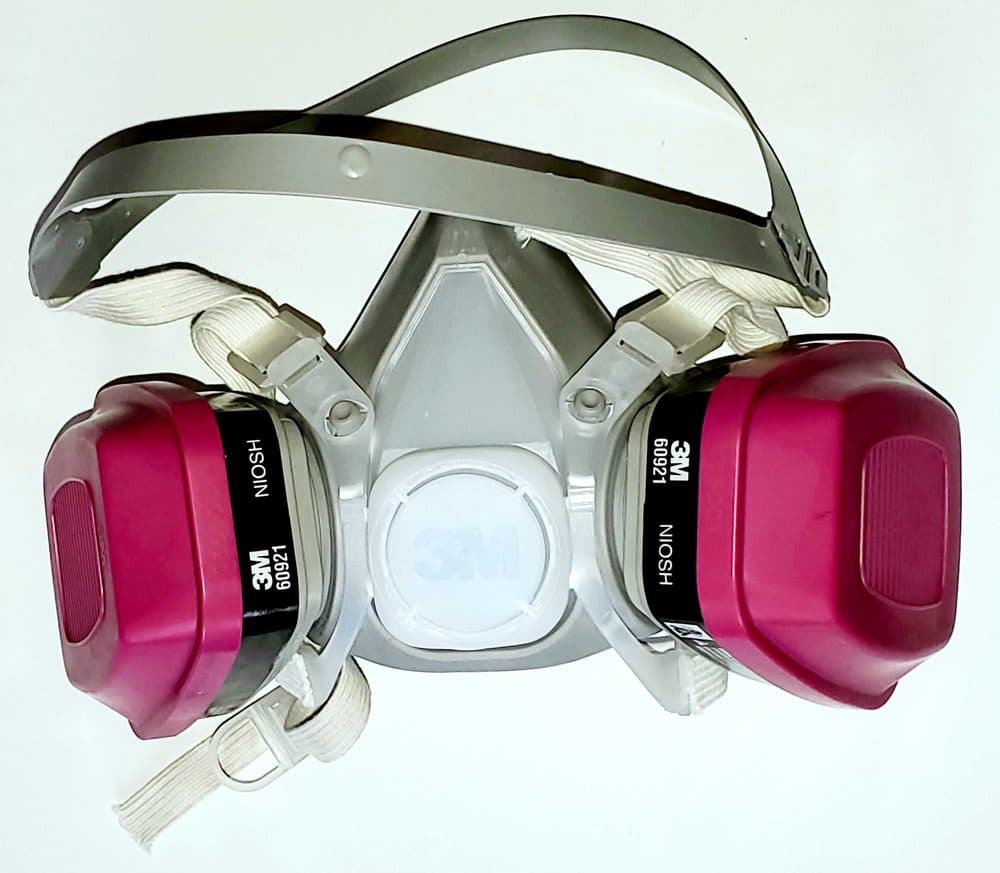 GVS Elipse P100 Half Mask Respirator (SPR457)A NIOSH P100 half mask small enough to wear under a magnifier visor. The right buy if you airbrush acrylics and sand resin, and the wrong one the moment a lacquer comes out. | The thing a booth does not replace | 8.5 | Check price on Amazon |
Scores are our own editorial read against the criteria stated below — not a lab measurement and not a user rating. Tap a row for the full write-up.
What we judged these on
A hobby spray booth is four parts: a box, a fan, a filter and a duct. Every booth on sale has all four, the boxes are much the same, and the filters are mostly the same fiberglass pad. So the decision comes down to four things:
- Extraction. How much air the fan actually moves, and whether it keeps moving it once there is a hose on the back. This is the whole product and it is the specification most listings describe worst.
- Capacity. Whether the model fits with room to move the airbrush around it. A 28 mm infantry model fits in anything. A Gunpla kit on a turntable, a tank hull or a sprue of parts does not.
- Quietness. The cost nobody budgets for. A booth you avoid using because of the noise is a booth that did not help, and the loud ones are genuinely loud.
- Portability. Whether it folds flat. For a hobby that lives on a dining table between meals this outranks everything else on the list.
Scores are our own editorial read against those four criteria, not a measurement — we have no anemometer and no sound meter, and we will not pretend otherwise. Dimensions, fan ratings and filter part numbers come from the makers’ own listings and from live retailer pages, all cited at the bottom.
Why the airflow numbers are a mess
Read five booth listings and you will see airflow quoted five ways: cubic meters per minute, CFM, watts, and in at least one case a number labeled CFM that is obviously a metric figure with the wrong unit printed next to it. A 25 W fan rated at 4 cubic meters per minute and a “5.2 CFM” fan are not telling you what you think they are telling you.
Two things are safe to rely on. First, a figure from a maker that publishes a complete set of specifications — Paasche lists one 6-inch fan, 235 CFM and 47 dB for the HSSB-22-16, and that internal consistency is itself a signal. Second, physical size: a 6-inch fan ducted into 4-inch dryer hose moves a different order of air from a 25 W computer-style fan pushing into flexible 4-inch tubing, regardless of how either is labeled.
The specification nobody prints at all is the one that decides whether your booth works: how long the duct run is. Every foot of hose and every bend costs you pull. A single-fan booth venting through 18 inches of hose into an open window is fine. The same booth pushing six feet across a room is noticeably worse, and that is the case where two fans earn their noise.
The two shapes, and who each one is for
The folding box
Almost every hobby booth sold is a collapsible fabric-and-wire box with a fan unit in the back wall, an LED strip, a turntable and a flexible hose. They fold to the thickness of a large book. Master Airbrush dominates this category in a handful of sizes, and a long tail of unbranded clones sells the same design more cheaply.
Buy this shape if the hobby shares a table with something else. The turntable is a bigger deal than it sounds — being able to rotate a primed model without touching it is the difference between an even coat and fingerprints in wet primer.
The steel bench booth
A rigid metal box with a proper squirrel-cage or axial fan, a duct collar for standard dryer hose and a replaceable filter pad. It does not fold, it weighs around 40 lb, and it extracts several times the air at a lower noise level.
Buy this shape if there is a permanent bench. The honest framing is that you are not buying more convenience, you are buying more extraction — which matters most to people spraying a lot, spraying often, or spraying in a room they also sleep in.
Measure the window before you buy the booth
This is the step that turns a good booth into a frustrating one, and it takes two minutes. Before you order anything, work out three things: where the booth sits, where the air goes, and what happens to both when you are not painting.
Where it sits. A folding booth needs its own footprint while it is open, plus room in front for your hands and the airbrush hose. A 22-inch booth on a 30-inch desk leaves you very little, and you will be reaching across the opening rather than working into it. Measure the desk, not the booth.
Where the air goes. The hose has to terminate outside: a sash window cracked a few inches, a casement window, a door, or a dryer vent. A sealed double-glazed unit that does not open is a hard stop, and no booth solves it. Measure the distance from the desk to the opening and compare it against the hose that ships with the booth, because the supplied hose is usually shorter than people expect.
What happens when you stop. A folding booth collapses to the thickness of a large book and slides behind a bookcase. A steel bench booth does not move, and the duct coming out of its back has to live somewhere between sessions too. If the hobby shares a room with anything else, this is the specification that decides the purchase, whatever the fan does.
There is a seasonal version of the same problem. Venting out of a window in January means heating the street for as long as you spray, which in practice means shorter sessions and a cold room. It is not a reason to skip the booth; it is a reason to batch your spraying so you open the window once. The desk side of this is covered in how to set up a painting desk.
Noise, honestly
Fan noise is the specification buyers discover after the purchase. Paasche publishes 47 dB for the HSSB, which is about the level of a quiet room and genuinely unobtrusive. The folding booths do not publish a figure, and the honest summary from how they are constructed is that a small fan moving air through a restrictive filter and a narrow hose is louder per unit of air moved than a big fan moving it through a 4-inch duct.
The dual-fan booth is the loudest thing on this page by a clear margin, and it is the direct trade for its extraction. That is worth knowing before you buy it rather than after: a booth loud enough that you avoid using it on a weekday evening has solved nothing. If you paint next to someone else or late at night, weight quietness higher than the airflow spec and vent through a short hose instead.
What a booth does not do
This is the part worth being blunt about, because the category markets itself as safety equipment and it is only half of that.
A booth captures overspray — the paint that misses the model and would otherwise settle on your desk, your keyboard and the wall behind it. It pulls that cloud away from your face and pushes it out of a window. That is genuinely valuable and it is the reason to own one.
A booth does not filter solvent vapor. With lacquers, Mr. Color, alcohol-based primers or anything that smells strongly of solvent, the fumes go wherever the air goes, which includes past your face on the way to the fan. Paasche says outright that the HSSB is not intended for hazardous, flammable or explosive materials, and that is the honest position for every hobby booth on the market. For those paints you want a respirator with the right cartridge as well as the booth, which is what the respirator roundup is for.
A booth also does not help at all if the hose does not reach outside. Vented into the same room, a booth is a device for moving your overspray four feet to the left. It needs a window, a dryer vent or an open door, every time.
Filters, hoses and the running costs
The filter is a consumable. Both shapes use a fiberglass pad — Paasche part number AG-8-3 for the HSSB, a generic cut-to-fit pad on the folding booths — and a clogged one strangles the fan long before it looks dirty. If extraction has quietly got worse, check the filter before you blame the booth.
Hoses are the other running cost nobody plans for. The hose that ships with a folding booth is short, thin-walled and prone to kinking, and a kink is a total loss of airflow. If the window is more than a couple of feet away, budget for better hose or for the dual-fan version.
Overspray in the booth is also a sign to read. A heavy layer of dry paint dust on the filter means the paint is drying before it lands, which usually means your pressure is too high or your paint is too thin for the distance you are spraying at. Our PSI settings page and how to thin paint for an airbrush cover the fix.
If you are here for Gunpla
Capacity is the deciding factor and most people get it wrong by one size. An HG kit on a 7.5-inch turntable is fine. A master grade with the backpack on, or a runner of parts held on a stick, needs the wide booth — and the moment the model touches a fabric wall you have transferred wet paint onto the booth and the booth onto the model.
The second Gunpla-specific point is paint chemistry. If you spray Mr. Color, Mr. Surfacer or a lacquer topcoat, the vapor limit above applies to you more than to anyone painting water-based acrylics on 28 mm miniatures. Booth plus respirator, not booth alone. The topcoat side of this is covered in matte vs satin vs gloss topcoat for Gunpla.
The setup that costs nothing
Worth saying because it is the right answer for some people: an open window with a box fan in it, drawing air away from you, with the model between you and the window. It controls the same cloud a booth controls, badly, and it costs nothing if you already own a fan.
What you lose is the turntable, the lighting, the filter catching paint before it reaches the neighbors, and the ability to spray in winter without heating the street. What you keep is the part that actually protects you, which is air moving away from your face. Whether that is enough for how you work is covered honestly in do you need a spray booth.
The verdict
Buy the large folding booth for most desks. A 22-inch workspace takes anything a hobbyist sprays, the LED and turntable earn their place every session, and it folds flat when the table has to be a table. This is the default and it is the right default.
Buy the dual-fan version if the window is across the room. Two fans hold their pull through a long duct run where one fan stalls. You pay for it in noise, and that is a real cost, not a footnote.
Buy the unbranded collapsible booth if money is the constraint. It is the same design executed more cheaply, and for occasional acrylic priming next to an open window it is enough. Expect a louder fan and a hose you will want to replace.
Buy the steel bench booth if you have a bench. 235 CFM at 47 dB is not a marginal upgrade over a folding box, it is a different class of machine, and the price reflects that. It will not fold and it will not move.
Buy the respirator regardless of which booth you pick. This is the one firm recommendation on the page. The booth handles overspray; the mask handles what you breathe. With lacquers they are not alternatives.
New to the airbrush side of the hobby entirely? Start at the beginner airbrush kits, and the compressor roundup covers the other piece of hardware a booth tends to arrive alongside.
The picks in full
Master Airbrush Large Portable Spray Booth (MAS B550LK)
A 22-inch folding booth with a 25 W extractor, LED lighting and a turntable. Big enough that a Gunpla kit on the turntable is not touching the walls, and it still folds flat when the table has to become a table again.
What it gets right
- The widest of the folding booths, which is what matters the moment you spray something bigger than a 28 mm model
- Turntable plus LED means you can see the coat you are laying down and rotate without touching the model
- Folds flat, so a dining-table hobby does not become a permanent installation
Who it is wrong for
- Does NOT replace a respirator for lacquers or alcohol-based paints — it moves overspray, it does not clean the air you breathe
- The hose has to actually reach a window; vented into the room it is a very elaborate fan
- The fan is audible enough that most people spray with headphones on
Scored against this page’s criteria
Specs from the manufacturer: Master Airbrush product page
We do not publish prices. Amazon shows the current one, which is the only one that is ever right. #ad · how this is funded
Portable hobby spray booth with extractor
A collapsible box with a fan, a filter and a duct hose. Not a substitute for a respirator, but the difference between overspray on the wall and overspray out of the window.
What it gets right
- Captures the overspray that otherwise settles on everything within a meter
- Folds flat, which matters when the hobby lives on a dining table
- The turntable alone makes spraying a model evenly much easier
Who it is wrong for
- Does NOT make a respirator optional for lacquers and alcohol-based paints
- The duct has to actually reach a window, or you are just moving air around the room
- Fan noise is real, and the cheap ones are loud enough to need headphones
Scored against this page’s criteria
We do not publish prices. Amazon shows the current one, which is the only one that is ever right. #ad · how this is funded
Master Airbrush Dual-Fan Spray Booth Kit (MAS B3000)
Two fans instead of one, four LEDs, a turntable and a six-foot hose. The pick if your window is across the room, because a long duct run is exactly what kills a single-fan booth.
What it gets right
- Two fans hold their pull through a long duct run, where one fan stalls and overspray drifts back at you
- Four LEDs instead of one strip, which genuinely changes how well you can see a thin coat going on
- Filter is a standard replaceable fiberglass pad rather than a proprietary cartridge
Who it is wrong for
- Two fans means twice the noise; this is the loudest booth on the page
- Still not a substitute for a respirator with lacquer, Mr. Color or alcohol-based primer
- Retailer listings quote its airflow in mismatched units, so treat any single CFM figure you read with suspicion
Scored against this page’s criteria
Specs from the manufacturer: Master Airbrush product page
We do not publish prices. Amazon shows the current one, which is the only one that is ever right. #ad · how this is funded
Paasche HSSB-22-16 Hobby Shop Spray Booth
A steel bench booth with a single 6-inch fan rated at 235 CFM and 47 dB, ducted to a 4-inch dryer hose. It does not fold, it is not light, and it extracts more air more quietly than any folding box.
What it gets right
- 235 CFM through a 4-inch duct is a different class of extraction from a folding booth's small fan
- 47 dB is quiet enough to hold a conversation next to, which no dual-fan folding booth manages
- Steel construction and a standard replaceable filter pad, so it is a buy-once item
Who it is wrong for
- Paasche states it is not intended for hazardous, flammable or explosive materials — read that as a hard limit, not fine print
- Around 40 lb and does not fold; this needs a dedicated bench, not a dining table
- Costs several times what a folding booth does, and the jump in capability is extraction, not convenience
Scored against this page’s criteria
Specs from the manufacturer: Paasche product page
We do not publish prices. Amazon shows the current one, which is the only one that is ever right. #ad · how this is funded
GVS Elipse P100 Half Mask Respirator (SPR457)
A NIOSH P100 half mask small enough to wear under a magnifier visor. The right buy if you airbrush acrylics and sand resin, and the wrong one the moment a lacquer comes out.
What it gets right
- Low profile: it clears a visor, a magnifier and most glasses in a way a cartridge mask does not
- P100 is the highest particulate rating available, which covers airbrush overspray and sanding dust
- Light enough that you keep it on for a whole session instead of pulling it down halfway
Who it is wrong for
- Particulate filters only — it does nothing at all about lacquer, enamel or solvent vapor
- Replacement filters are a proprietary GVS shape, so you are tied to their supply
- Sized M/L in the common kit; a smaller face may not seal, and a mask that does not seal does nothing
Scored against this page’s criteria
Specs from the manufacturer: GVS product page
We do not publish prices. Amazon shows the current one, which is the only one that is ever right. #ad · how this is funded
FAQ
Questions people actually ask
What is the best spray booth for airbrushing miniatures?
Do I need a spray booth to airbrush indoors?
Does a spray booth stop you needing a respirator?
How much airflow does a hobby spray booth need?
Will a Gunpla kit fit in a portable spray booth?
How often do you change a spray booth filter?
Can you vent a spray booth into the room?
More in Airbrushing Miniatures and Models, or start from the beginning with what to buy first.
Sources
- Paasche Airbrush — HSSB-22-16 Hobby Shop Spray Booth: 22 x 20 x 16 in working size, one 6 in fan, 235 CFM, 47 dB, 4 in duct adapter, AG-8-3 filterschecked November 2026
- Blick Art Materials — Paasche Hobby Shop Spray Booth listing, including shipping weightchecked November 2026
- TCP Global — Master Airbrush MAS B550LK large portable spray booth: 22.25 x 19 x 14 in workspace, 25 W fan, LED, 7.5 in turntablechecked November 2026
- TCP Global — Master Airbrush MAS B3000 dual-fan spray booth kit: twin fans, 4 LEDs, 7.5 in turntable, 6 ft hose, fiberglass filterchecked November 2026
- GVS — Elipse P100 half mask respirator, NIOSH approval and filter specificationchecked November 2026